Which enclosure style should I choose — open-top, semi-enclosed, or fully enclosed?
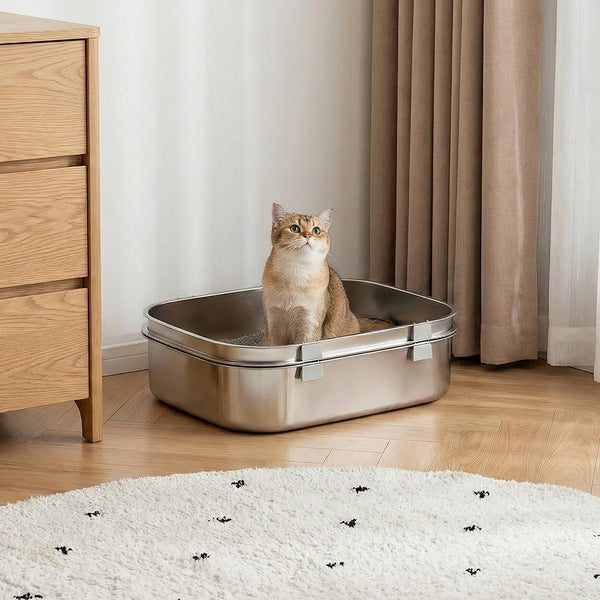
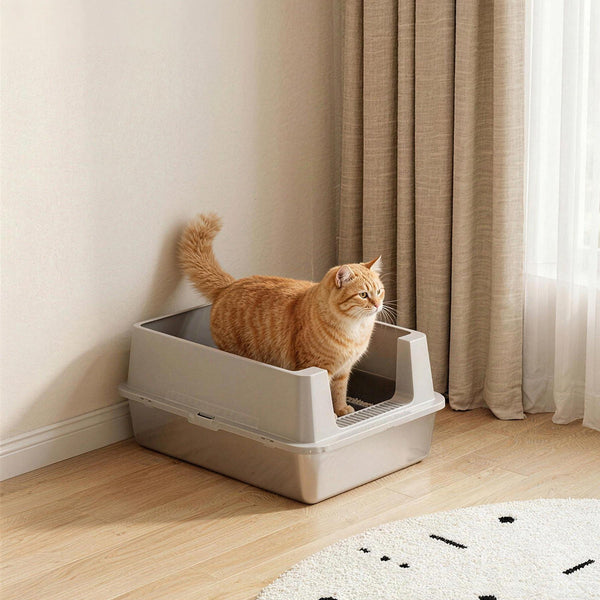
Match the style to your cat, not to the look. Open-top suits confident cats and owners who want to see everything at a glance. Semi-enclosed adds a half-lid that cuts tracking and gives shy cats some cover. Fully enclosed gives the most privacy, for cats that like to hide. If your cat has never used a covered box, start with open-top or semi — the lids are interchangeable on the same base.
My cat pees standing up or over the side. Which style stops the mess?
Go tall. Pick the fully enclosed model — it is 23 in long, 16.7 in wide and 17 in high, with an 11.2 × 8.6 in door, so the walls clear a standing cat rather than just a sitting one. If your cat sprays backwards over the edge, a top-entry lid is the single most effective fix.
What's the difference between top-entry and front-entry lids?
Top-entry means the cat jumps in through the roof. It contains litter tracking best and stops over-the-edge spraying, but it is harder for kittens, seniors, or cats with arthritis. Front-entry has a door on the side: easier at every age, with slightly more tracking. Both fit the same XL base, so you can swap later.
My cat is a senior or has arthritis — which style is easiest?
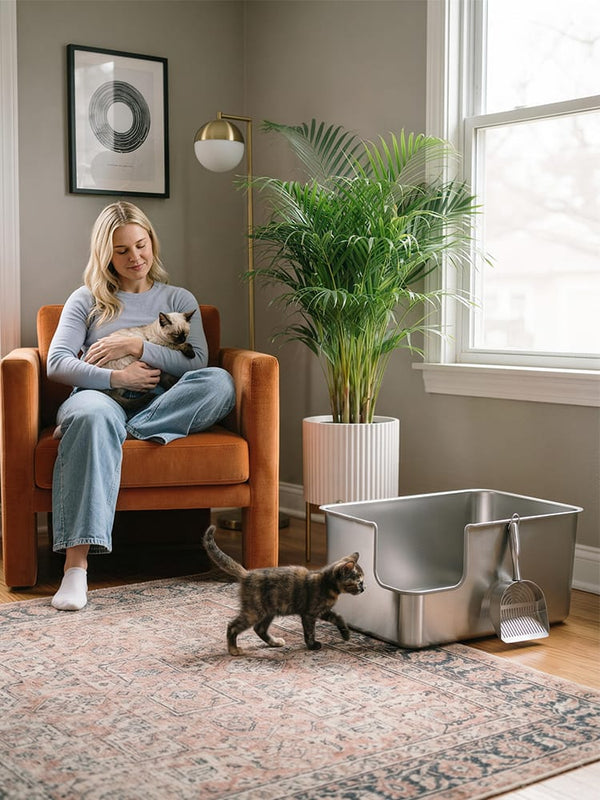
Choose open-top or semi-enclosed. The open-top base is only 7.7 in high with an interior depth of 6.3 in, so your cat steps in rather than climbs. A covered box with a single narrow door is the hardest style for an older cat — if yours has started avoiding the box, switching to a lower, more open style often fixes it on its own.
Which litter works best in this box — clumping clay or pine pellets?
This model is built for clumping litter. The sifting pan has fine slots that let clean, unclumped litter fall through while holding the clumps. Pine pellets behave differently — they break down into sawdust instead of forming clumps — so if you want pine, choose our Pine Sifting model, whose slot size is tuned for pellets.
Why are my clumps sticking to the bottom of the pan?
Almost always litter depth or wait time. Keep 2–3 inches of litter so urine never reaches the steel, and scoop daily — clumps left for days harden onto the pan. Stainless steel is non-porous, so once depth and timing are right, sticking stops.
How does the sifting system actually work?
Two parts: a solid stainless base pan that holds the litter, and a slotted sifting pan that nests inside it. Lift the sifting pan and clean litter drops back into the base while the clumps stay on top. You remove only the waste, never the whole box of litter, so you top up instead of replacing.
How often do I need to scoop, and how often do I deep clean?
Scoop daily — each pass takes seconds. Wipe the pans with mild soap and warm water as needed, and do a full wash every 2–4 weeks. Stainless steel does not absorb urine the way plastic does, so there is no odor reservoir to scrub out.
How much time and litter does a sifting box actually save?
Two concrete numbers. Cleanup takes about 3 seconds and you do it once a day — you lift the sifting pan and tip the waste, instead of scooping through the whole box. And because the clean litter falls back into the base rather than being thrown out with the waste, high-density sifting saves around 30% of your litter compared with scooping a standard box — over a month, that is a noticeable amount you are not buying.
What are those white rings or rainbow film — is it rusting?
No. Stainless steel does not rust from cat urine. White rings and a faint rainbow film are dried mineral deposits from water and urine; a vinegar or citric-acid wipe with a soft cloth removes them. Orange-brown pitting would be rust, and is not expected on 304 stainless in normal use.
What size do I need — and how big is XL?
Aim for a box at least 1.5× your cat's body length, nose to tail base. The XL base is 22.8 in long, 16.1 in wide and 7.7 in high, with an interior depth of 6.3 in — comfortable for most adult cats including large breeds. For cats over about 15 lb, size up to XXL.