


![Is the Sifting Pan Too Heavy? Techniques for [Petite Owners]](http://www.furrbby.com/cdn/shop/articles/Google_AI_Studio_2025-12-16T09_03_13.511Z.png?v=1765875981&width=360)
Is the Sifting Pan Too Heavy? Techniques for [Petite Owners]
by Taylor Claier on Dec 15, 2025
An automatic litter box can weigh over 44 pounds empty, creating a significant usability problem for many customers. For petite users or those with physical limitations, this weight isn't just an inconvenience—it's a barrier that directly impacts product satisfaction and retention.
This analysis examines the design principles and user techniques that make heavy litter boxes manageable. We will explore how modular systems isolate lifting to lighter components, like a 13–24 lb waste drawer, and how ergonomic features can enable controlled pouring. We also cover simple adjustments to litter depth and placement that can improve safety and the overall user experience.
Expected Outcome (Easy Lift)
The 'easy lift' outcome is a system where you primarily handle lighter, removable parts like a waste drawer (13–24 lbs) instead of lifting the entire 30–50 lb unit. This is achieved by selecting compact models around 21-23 lbs empty with a modular design for simpler maintenance.
Handling Lighter Components, Not the Full System
The main goal of a modular design is to avoid lifting the entire unit, which can weigh over 30 lbs when loaded with litter and waste. Routine maintenance involves handling only the waste drawer or inner globe, keeping individual lifts lighter and more manageable. This modular approach means the heavy base unit can stay in place, while you only interact with its lighter parts for day-to-day cleaning.
Key Weight Benchmarks for Easy Handling
Compact automatic boxes with an empty weight of around 21–23 lbs (9.5–10.5 kg) are ideal for easier handling. The most frequently lifted component, a full waste drawer, typically weighs between 13 and 24 lbs (6–11 kg). This isolates the heaviest tasks into manageable components. By contrast, larger "XL" models often start at 44 lbs (20 kg) when empty, making the entire unit difficult to move without sliding or assistance.
Before You Begin: Weight Limits
Automated litter boxes have specific cat weight requirements, typically from a minimum of 3.5 lbs to activate sensors up to a maximum of 30 lbs for larger breeds. The units themselves can be heavy, weighing between 26 to 44 pounds, which is an important factor for setup and cleaning.
Cat Weight Requirements for Safe Operation
A cat’s weight is a key factor for the safe operation of an automated litter box. A minimum weight is necessary to activate the safety sensors that detect when a cat enters and exits the unit. This threshold is typically around 3 pounds 8 ounces (1.58 kg), ensuring the device will not start a cleaning cycle with a small kitten inside. Maximum weight capacities vary to accommodate larger breeds. Some models, like the Whisker Litter-Robot, support cats up to 30 pounds, while others are designed for cats weighing up to 20 or 25 pounds (11.3 kg), so you must match the product's specifications to your cat's size.
Product Weight and Handling Considerations
Beyond your cat's weight, the physical weight of the litter box itself is an important practical consideration. These units are often substantial, weighing anywhere from 26 to 44 pounds. For instance, the CATLINK Scooper Pro-X weighs 26.45 pounds, while a Homerunpet unit comes in at a much heavier 44 pounds. This weight can make initial setup, routine cleaning, and moving the device a challenge, especially for users who have difficulty lifting heavy items.
Technique 1: The "Tilt & Pour"
The 'Tilt & Pour' is a controlled method for emptying heavy litter boxes by using built-in features like pour spouts and dual handles. Found on products like the Litter Genie box, these designs create a stable pivot point, channel the litter, and reduce wrist strain and messy spills.
The "Tilt & Pour" is a specific technique engineered to make emptying a heavy litter pan safer and less physically demanding. Instead of just tipping the box and hoping for the best, this method relies on design features that control the flow of litter and stabilise the load. Manual litter boxes often incorporate handles and spouts, while automated systems motorise the same core principle. The table below compares how these features are implemented across different system types.
| Feature | Manual Systems (Example) | Automated Systems (Example) |
|---|---|---|
| Pour Mechanism | Integrated pour spout and dual side handles to create a pivot edge and support a two-handed grip (Litter Genie, IRIS Flexi). | Motorised globe or pan rotation, often up to 45°, to mechanically empty waste and litter (Neakasa M1, Litter-Robot 4). |
| Engineered Load | Designed for "maximum load weight," relying on user strength guided by handles for stability. | Built for defined loads, such as 6.5–7 L of litter and cats up to 10 kg (≈22 lb), with waste bins holding up to 11 L (CATLINK Scooper SE). |
Using Spouts and Handles for a Controlled Pour
Some manual litter boxes, like the Litter Genie Litter Box and IRIS Flexi pan, integrate a pour spout directly into the pan's structure. This spout serves as a clear pivot edge, giving you a stable point to rotate the pan around. It also creates a narrowed channel that directs the flow of litter into a trash bag, which prevents the wide, messy spills common with standard rectangular boxes. To manage the weight, these products include dual side handles that enable a secure, two-handed grip. This grip distributes the load and gives you better rotational control, reducing the strain on your wrists as you handle a full, heavy pan.
How Automated Systems Apply This Principle
Automatic systems like the Neakasa M1 and Litter-Robot 4 motorise the tilt-and-pour concept. Instead of relying on your strength, these devices use a motor to perform a controlled rotation, often up to 45 degrees, to separate waste or empty the litter. Their designs are based on defined loads. For example, systems are engineered with internal litter capacities around 6.5–7 L and separate waste bins holding up to 11 L. Products like the CATLINK Scooper SE are built to handle cats weighing up to 10 kg (≈22 lb), confirming that the rotational mechanics are validated for the specific mass they are designed to move.
The Last Litter Box You'll Ever Need
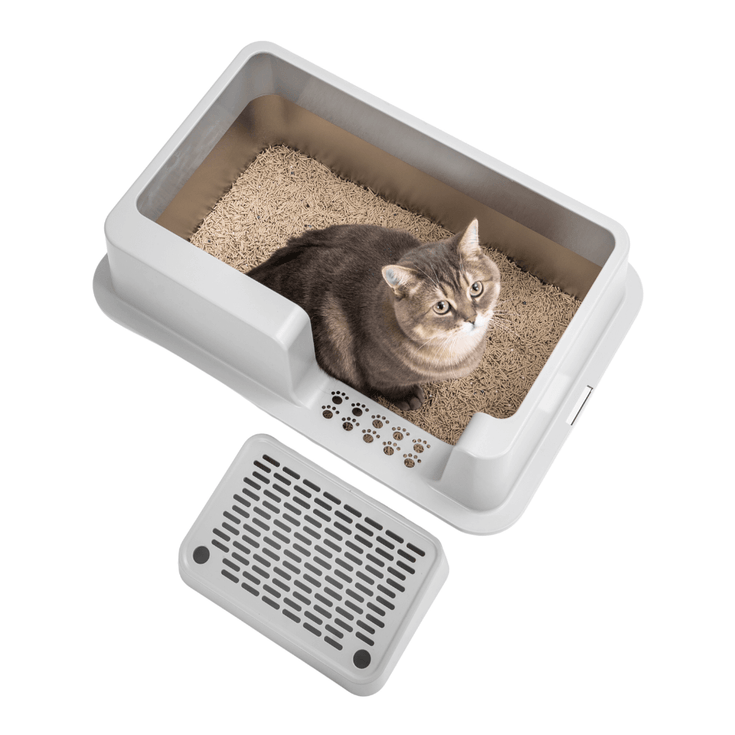
Technique 2: Lower Litter Levels
Lowering litter levels to an optimal 2-3 inches significantly reduces the total weight of the box, making it easier to lift and clean. This depth, especially with standard-weight clay litter, provides a firm, stable surface for heavy cats, preventing them from sinking as they might in lighter litters.
| Litter Material | Optimal Depth | Stability for Heavy Cats |
|---|---|---|
| Standard-Weight Clay | 2–3 inches | Provides a firm, stable base that prevents sinking. |
| Lightweight Formulas | Not Recommended | Feels unsteady and allows cats to sink, posing a problem for cats with mobility issues. |
The 2-Inch Rule: Reducing Weight Without Compromise
Adopting a shallower litter depth directly addresses the challenge of managing a heavy litter box. By reducing the total volume of litter, you significantly decrease its overall weight, which makes it easier to handle and reduces back strain during scooping and refills. A depth of about two inches is sufficient for a large cat to dig and cover waste, especially when using an oversized litter box that provides ample surface area. This approach also reduces how much litter you use with each refill, making each bag or container last longer.
Material and Depth for Maximum Stability
For optimal stability, especially for larger or mobility-impaired cats, maintain a consistent litter depth of 2–3 inches in an extra-large box. This depth ensures functionality without adding unnecessary weight. Use standard-weight clay litter, as its density creates a firm, stable base that prevents a heavy cat's paws from sinking. You should avoid lightweight litters because they can feel unsteady and shift under a heavy cat's weight, which is a significant concern for felines with arthritis or other mobility challenges.
Troubleshooting: Back Safety
To protect your back, choose a larger, low-sided box and place it in an open, accessible area. Scooping the box daily keeps waste clumps small and light, and elevating the box to waist-height can eliminate the need for deep bending.
Evaluating Box Size and Placement
The ideal litter box should be at least 1.5 times the length of your cat, giving them ample space to turn and dig. Many commercial boxes are smaller, which concentrates waste and weight into a compact area. A larger box distributes waste more evenly, but the key is to also choose one with low sides. A low-sided design reduces how much you need to bend and reach over a high wall, which is easier on your back and also helps cats with mobility issues.
Where you put the litter box matters just as much. Placing it in a quiet, easily accessible area prevents awkward movements. Sticking a box in a tight closet or cramped basement forces you to twist and reach when lifting or scooping, increasing the risk of back strain.
Adjusting Your Cleaning Frequency
Scooping the litter box at least once a day is one of the most effective ways to make the task physically easier. Daily scooping prevents large, heavy clumps from forming. This reduces the peak weight you lift each time you clean, lowering the cumulative load on your spine.
Since plastic litter boxes absorb odours and degrade, they should be replaced every six months. This regular replacement cycle means you can use lighter-weight plastic containers instead of heavy, permanent ones. To eliminate deep bending, you can position the box on a sturdy, waist-high stand or bench. This simple change can significantly reduce the physical stress of scooping.
Final Thoughts
Managing a heavy sifting pan doesn't have to be a struggle. The best approach combines choosing the right equipment with smart techniques. For automated systems, this means finding a modular design where you only handle a lighter waste drawer. For manual boxes, using features like pour spouts or simply lowering the litter depth to 2-3 inches can drastically reduce the weight you need to lift. These methods shift the focus from lifting a heavy 30+ pound unit to managing smaller, lighter parts.
Ultimately, keeping a litter box clean is less about physical strength and more about your setup. By choosing a box that fits your body and placing it where you can easily access it, you prevent awkward bending and straining. Daily scooping and replacing the box regularly also keeps the task light and manageable. It's about working smarter, not harder, to create a system that works for both you and your cat without risking back pain.
Frequently Asked Questions
How heavy is a sifting litter box?
Sifting litter boxes weigh between 2 lb and 8 lb empty, based on product specifications from major retailers; plastic models typically range 5-8 lb, while lighter disposable or smaller units are around 2 lb, and heavier stainless steel versions reach 9.5 lb (4.3 kg).
Can a petite person lift a sifting box?
Yes. Most commercial sifting litter boxes, when filled to their manufacturer‑specified capacity, weigh in the 10–25 lb (4.5–11.3 kg) range, which is within common ergonomic lifting limits for smaller adults, especially if lifted with two hands and no trunk twisting. A petite user specifically seeking lighter handling should choose plastic models around 10–15 lb loaded, or stainless-steel systems kept below full volume.
Is there too much litter in my sifting box?
For most sifting litter systems, you’re using too much litter if the depth exceeds about 2–3 inches for clumping litter or 1–2 inches for pellet litter, or if the total load is over the unit’s rated capacity (e.g., ~11 lb / 305 in³ for some enclosed sifters). Above these levels, the litter cannot move freely through the sifting slots, clumps break apart, and the mechanism or trays may bind or overload.
How to lift a heavy litter box safely?
For a petite user, a heavy litter box should be treated like any other manual load: do not lift it manually if it is over about 35 lb (16 kg); use a scoop, smaller containers, or mechanical aids, and if you must lift, keep the weight under roughly 25–35 lb and use a squat lift keeping the box close to your body. Above 50 lb (23 kg), university and safety guidelines state it should be a two‑person lift or the use of equipment, not a solo lift.
Do I have to lift the whole pan to sift?
No, you do not have to lift the whole pan to sift in modern self-cleaning litter boxes designed for heavy litter loads; these feature automated sifting mechanisms with separate waste bins or drawers (capacities 11.23L to 13L) that allow waste removal without elevating the main pan, reducing lift weight to under 27 lbs empty.
Are there lightweight sifting boxes?
Yes, lightweight sifting boxes and screens exist, primarily in mini stackable designs for prospecting and classification, constructed from 304 stainless steel wire mesh with green plastic frames at 6-inch diameter.
Managing Pine Pellets for 3+ Cats: Capacity & Frequency Guide
Sifting vs. Traditional Scooping: Why You Should Ditch the [Poop Shovel]
Navigating in the Dark: Why Tactile Cues Matter for Blind Cats
Gunmetal vs. Silver: Choosing the Right Finish for Your Bathroom