


Navigating in the Dark: Why Tactile Cues Matter for Blind Cats
by Laura Jane on Jun 16, 2026
Developing effective pet products for special needs animals requires a deep understanding of their unique challenges. For blind cats, a critical area involves facilitating confident and consistent use of their litter box, which directly impacts their well-being and household harmony.
Cats rely heavily on touch, developing a remarkable 7 to 25 tactile pads per square centimeter of skin by just seven weeks of age. Leveraging this sensory ability, we explore the importance of tactile cues in their environment, discussing optimal litter box specifications. For instance, recommended designs often feature an entrance around 9 by 12 inches and walls up to 15 inches high, tailored to help blind cats orient themselves and prevent accidents.

Experience the Purr-fect Clean: Stainless Steel Litter Boxes
Final Thoughts
Creating a supportive environment for blind cats centers on reliable tactile and spatial cues. For their litter boxes, this means choosing designs with clear, accessible entries and considering the interior dimensions that provide ample space. Placing the box in a consistent, easily locatable spot, perhaps near other familiar objects, helps your cat build a mental map of their territory. Training also thrives on routine, where touch and sound guide them through the process, solidifying their habits.
Attending to these specific sensory needs significantly boosts a blind cat's confidence and ability to move freely in their home. This deliberate approach to their environment, from stable litter box locations to varied textures at key points, empowers them to navigate independently. It allows these resilient animals to live full, comfortable lives, proving that a lack of sight doesn't mean a lack of joy or function.
Frequently Asked Questions
How can I help my blind cat find their litter box?
While there isn't a single industry standard, veterinary guidance suggests using a large, open-top litter box with a low, wide entrance. Place it in a fixed, easily traceable spot, usually near their food/water and along a wall. This allows your cat to orient using touch and smell. A practical size is approximately 16–26 inches long, 14–20 inches wide, with 5–8 inch high walls and an entrance lip no more than 5–6 inches. Always keep it in the same spot and consider one box per floor of your home.
What are the steps for litter box training a blind cat?
Start by confining your blind cat to a small room or a large crate. Place a shallow, uncovered litter box at one end, opposite their food, water, and bedding. Gently place your cat in the box multiple times daily, rustling the litter to provide auditory cues. Use fine-grained, unscented clumping clay litter, or test preferences with multiple box types side-by-side. Scoop the box twice a day. Maintain this confinement for 2-4 weeks to establish reliable habits before gradually reintroducing them to other rooms, each with its own litter box.
How do tactile cues assist cats with orientation?
Cats are highly sensitive to touch, with 7–25 specialized tactile pads per square centimeter of skin by 7 weeks of age. While there’s no formal engineering standard, using distinct surface textures at key wayfinding points – like a smooth plastic mat versus ribbed rubber or a coarse mat – can help blind cats orient themselves. Placing these different textures at doorways, approach paths, or around the box rim provides clear physical markers for navigation.
Which litter box design is best for cats with vision loss?
For blind cats, an optimal litter box offers easy navigation. An entrance of about 9 x 12 inches is recommended, leading to an interior litter area at least 14 inches wide by 20 inches deep by 6 inches high. High-sided walls, around 15 inches tall, help prevent misses, accommodating cats up to 22 pounds. The key is ensuring sufficient space and clear entry/exit points for confidence and ease of use.
What sensory features do Furrbby litter boxes offer for blind or mobility-challenged cats?
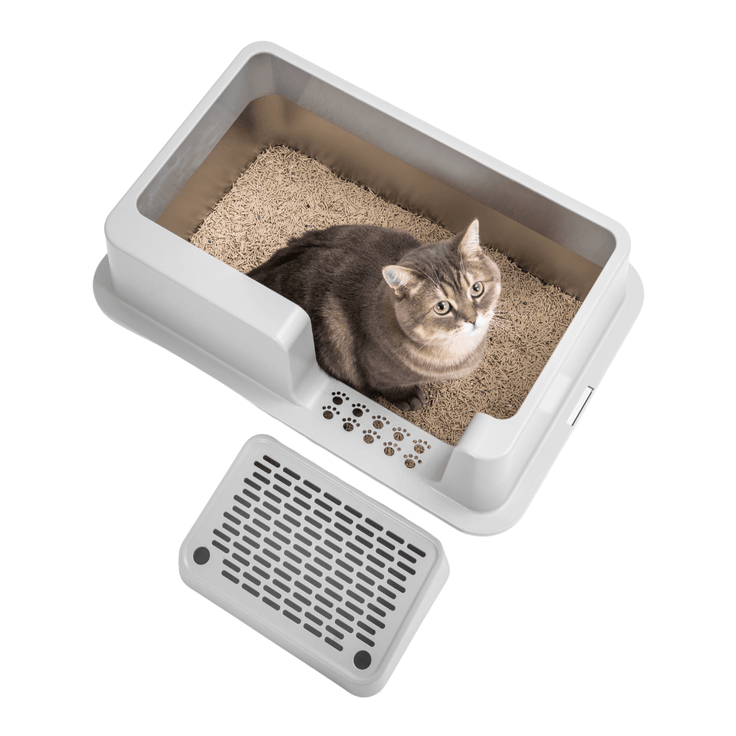
Furrbby litter boxes do not use electronic sensors; instead, their sensory support comes from purely physical, tactile, and spatial design. This includes large entry openings, dual entries, and top exits for consistent routes. Features like separate step platforms with a grate design create distinct tactile surfaces for entry/exit. High side walls (up to 15-16 inches) and a 6-inch enclosure ring provide strong physical boundaries. A non-porous stainless-steel pan with smooth, rounded corners ensures a consistent, easily recognizable floor texture and minimal odor, aiding scent-based orientation. The interior footprint is generous: 23.9 inches (L) × 15.9 inches (W), with heights of 12.2–15.4 inches.
Can I move my blind cat's litter box, and if so, how often?
There is no industry standard for moving a blind cat’s litter box. Veterinary guidance strongly recommends keeping the litter box in a fixed, consistent location once your cat has learned its position. If relocation is absolutely necessary, do it very gradually – moving it only inches per day – while providing additional tactile and scent cues to help your cat remap their space. Spatial re-mapping for visually impaired animals can take several days to weeks, emphasizing the importance of stability.
Managing Pine Pellets for 3+ Cats: Capacity & Frequency Guide
Sifting vs. Traditional Scooping: Why You Should Ditch the [Poop Shovel]
Gunmetal vs. Silver: Choosing the Right Finish for Your Bathroom