


![2 Types of Sifting Systems: [Standard vs. Pine] Explained](http://www.furrbby.com/cdn/shop/articles/Lucid_Origin_A_more_symbolic_and_contemplative_stilllife_scene_0_8eda9d4c-a9c3-435f-859c-9fdab52efdf8.jpg?v=1766222887&width=360)
2 Types of Sifting Systems: [Standard vs. Pine] Explained
by Taylor Claier on Dec 18, 2025
Sifting litter boxes are engineered for specific litter types; however, a mismatch between the box and the litter can lead to poor performance and customer complaints. A system designed for clumping clay will not function properly with pine pellets, and vice versa. Understanding the mechanical differences is key to stocking the right inventory and advising consumers effectively.
This article explains the two main sifting systems: standard models for clay and specialized sifters for pine. We'll compare how each separates waste, from the 2–5 mm slots needed for clay to the larger grates that filter sawdust from pine pellets. We will also examine how this choice affects annual costs, which can range from as low as $21 for pine users to over $150 for those using clay.
Industry Manufacturers List
Quick Comparison: Top Picks
| Manufacturer | Location | Core Strength | Verdict |
|---|---|---|---|
| Two-Tray Pine Pellet Sifting System | Industry Wide | Key functional requirement: stacked double-tray box where the upper tray has holes/slots sized to pass sawdust but retain intact pine pellets; designed for disintegrating pellet litters that break down on contact with urine. | Ideal for home and multi-cat households using pine pellets who want reduced odor, low dust, and minimal daily litter replacement via mechanical sifting instead of full-box changes. |
| Breeze-Style Pine Pellet Conversion System | Industry Wide | Key metric/requirement: rigid, stable upper grate with hole size small enough for paws but large enough for urine flow, combined with a shallow lower pan sized for disposable absorbent pads or for periodic dumping of collected sawdust. The system is optimized for kiln‑dried, additive‑free pine or hardwood pellets that disintegrate to sawdust on wetting. | Best for breeders, catteries, and cost‑sensitive owners who want the Breeze mechanical layout but prefer cheaper or more natural pine pellets, while maintaining strong urine odor control and easy pad-based cleanup. |
| Oversized Sifting Pan with Support Grid for Pine Pellets | Industry Wide | Key metric/requirement: robust inner sifting tray or mesh panel capable of supporting several kilograms of pine pellets and cat weight, with aperture geometry tuned to pass sawdust but retain pellets; compatible with any standard kiln‑dried pine pellet brand. | Suits multi-cat homes and larger breeds needing a bigger box, where users want pine’s low dust and odor control with manual sifting capability, avoiding proprietary cartridge systems. |
Two-Tray Pine Pellet Sifting System
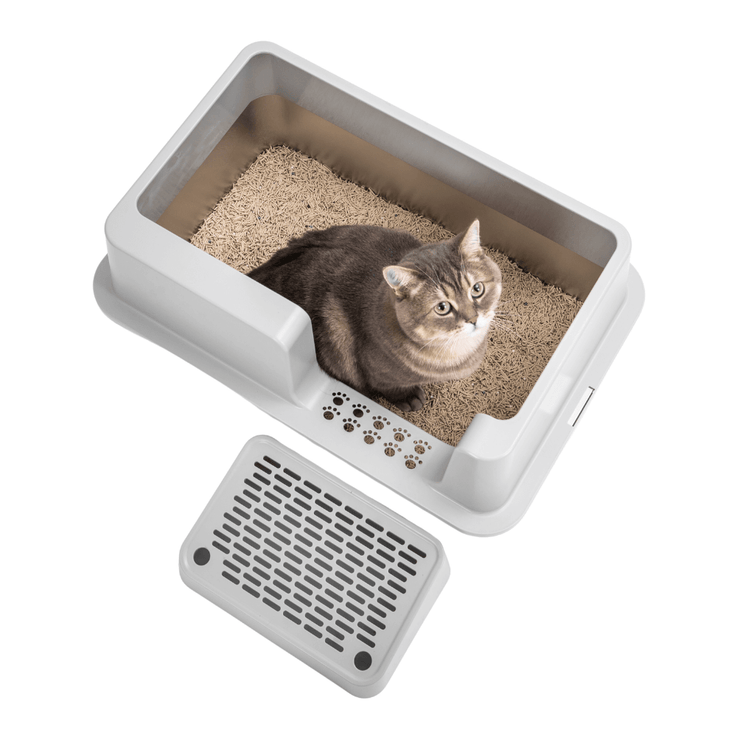
A two-tray pine pellet sifting system works by separating used and fresh litter. The top tray has perforations and holds the pine pellets. A solid tray sits underneath to catch sawdust that forms when urine breaks down the pellets. This design keeps clean, whole pellets on top while isolating the wet sawdust below.
This separation process improves hygiene and makes the litter last longer. Solid waste is easy to scoop from the top tray. You only need to discard the saturated sawdust from the bottom tray, which simplifies daily maintenance and reduces overall litter consumption.
At a Glance:
- 📍 Location: Industry Wide
- 🏭 Core Strength: Stacked double-tray box where the upper tray has holes sized to pass sawdust but retain intact pine pellets; designed for disintegrating litters.
- 🌍 Key Markets: Home and multi-cat households using pine pellets, seeking a solution for reduced odor, low dust, and minimal litter replacement through sifting.
Why We Picked Them:
| ✅ The Wins | ⚠️ Trade-offs |
|---|---|
|
|
Breeze-Style Pine Pellet Conversion System
This variation repurposes a Breeze-style plastic frame and grated upper tray, originally designed for clay pellets and pads, and replaces the proprietary pellets with kiln‑dried pine or hardwood fuel pellets. Urine passes through the grated top into an absorbent pad or open tray beneath, while the pine pellets gradually break down and can be shaken or sifted so fines fall away from the clean pellets.
Users often substitute lower-cost puppy training pads and bulk wood pellets to reduce operating costs while preserving odor control. The approach is popular with breeders, catteries, and cost-sensitive owners who want the Breeze mechanical layout but prefer cheaper or more natural pine pellets over proprietary ones, while maintaining strong urine odor control and easy pad-based cleanup.
At a Glance:
- 📍 Location: Industry Wide
- 🏭 Core Strength: A rigid, stable upper grate with holes large enough for urine flow but small enough for paws, combined with a shallow lower pan sized for absorbent pads or sawdust collection. The system is optimized for kiln-dried pine pellets that disintegrate on wetting.
- 🌍 Key Markets: Breeders, catteries, and cost-sensitive owners who want the Breeze mechanical layout but prefer cheaper or more natural pine pellets, while maintaining strong urine odor control and easy pad-based cleanup.
Why We Picked Them:
| ✅ The Wins | ⚠️ Trade-offs |
|---|---|
|
|
Oversized Sifting Pan with Support Grid for Pine Pellets
This design uses a large conventional litter pan fitted with a removable internal sifting insert or support grid to hold pine pellets above a lower cavity that collects sawdust. The owner periodically lifts and shakes the inner grid so broken‑down fines fall into the bottom section, then discards the accumulated sawdust while returning intact pellets to service. The oversized footprint improves stability and provides more surface area for cats that dislike confined boxes.
This system is particularly well-suited for multi-cat homes and larger breeds that require a bigger box. It meets the needs of users who appreciate the low dust and odor control of pine but also want a manual sifting capability that avoids proprietary cartridge systems, allowing them to use any standard kiln-dried pine pellet brand.
At a Glance:
- 📍 Location: Industry Wide
- 🏭 Core Strength: A robust inner sifting tray capable of supporting heavy loads, with aperture geometry designed to separate sawdust from usable pellets.
- 🌍 Key Markets: Multi-cat homes and owners of larger cat breeds who want a low-dust, odor-controlling pine litter solution with manual sifting.
Why We Picked Them:
| ✅ The Wins | ⚠️ Trade-offs |
|---|---|
|
|
Prioritize your cat’s texture preference and digging behavior
Choose clay if your cat prefers a fine, sand-like texture that closely mimics outdoor soil and allows easy digging and burying of waste. You should opt for pine pellets only if your cat tolerates or likes larger, harder pellets. Many cats dislike how pellets feel under their paws and may avoid the box entirely.
The primary factor to consider is the granule size and feel—comparing fine, sand-like clay against large wood pellets. Observing whether your cat easily covers waste in test trays of each litter type is a practical selection method to determine their comfort and acceptance.
At a Glance:
- 📍 Location: Industry Wide
- 🏭 Core Strength: Key metric: Granule size and feel — fine, sand-like clumping bentonite clay vs. large wood pellets or refined clumping pine granules.
- 🌍 Key Markets: Application: Feline comfort testing, litter acceptance studies, behavioral suitability in multi‑cat homes.
Why We Picked Them:
| ✅ The Wins | ⚠️ Trade-offs |
|---|---|
|
|
Match litter type to sifting litter box mechanics
Sifting litter boxes are designed to separate waste from clean litter, and their effectiveness often hinges on the type of litter used. With clumping clay, the system is quite efficient. Clean granules are small enough to fall through the sieve, leaving the larger clumps of waste behind for easy disposal.
The mechanics change when using pine pellets. Intact pellets are often too large to pass through the grates. Only the urine-soaked pellets, which break down into sawdust, will fall through. This means users must still scoop solid waste and also periodically sift the box to separate the sawdust. Engineers and designers should focus on the relationship between grate aperture, pellet diameter, and the resulting sawdust particle size to optimize performance.
At a Glance:
- 📍 Location: Industry Wide
- 🏭 Core Strength: Key metric: Sieve aperture and particle size compatibility — clay granule size vs. pine pellet diameter and resulting sawdust fineness.
- 🌍 Key Markets: Application: Sifting litter box engineering, ergonomics studies, maintenance‑time optimization.
Why We Picked Them:
| ✅ The Wins | ⚠️ Trade-offs |
|---|---|
|
|
Evaluate dust generation and respiratory impact
Clumping clay litters can release substantial airborne dust when poured or agitated, raising concerns about respiratory irritation for cats and humans. Pine pellets are considered a low‑dust option; when wetted, pellets break down into heavier sawdust that tends to fall through the litter and does not form large dust clouds.
Selection for sensitive populations should be based on quantified dust loading and particle size distribution during simulated use. The key difference lies in how each material behaves, with pine breaking down into larger particles that are less likely to become airborne compared to the fine dust from clay.
At a Glance:
- 📍 Location: Global Standard
- 🏭 Core Strength: Key metric: Dust load and particle size (PM10/PM2.5) during pouring and use; qualitative classification as “high‑dust clay” vs. “low‑dust pine pellets.”
- 🌍 Key Markets: Application: Respiratory health risk assessment, allergy‑sensitive and asthma‑sensitive household recommendations.
Why We Picked Them:
| ✅ The Wins | ⚠️ Trade-offs |
|---|---|
|
|
Compare odor control performance and coverage behavior
Many clay-based litters manage odors by clumping around urine and releasing artificial fragrances. While this approach can be effective, the added scents sometimes irritate cats and may only mask underlying smells instead of eliminating them.
Pine litters provide a different solution, using high absorbency and a natural wood aroma to actively neutralize ammonia. But pellet-based pine may not always fully cover solid waste, potentially leaving odors exposed. A data-driven comparison is necessary to measure ammonia levels over time and observe actual coverage rates to understand the true performance of each type.
At a Glance:
- 📍 Location: Industry Wide
- 🏭 Core Strength: Analyzes ammonia and VOC reduction, fragrance type (synthetic vs. natural), and solid waste coverage rates.
- 🌍 Key Markets: Odor-control benchmarking, fragrance-free product development, and air quality studies for small homes.
Why We Picked Them:
| ✅ The Wins | ⚠️ Trade-offs |
|---|---|
|
|
Account for tracking, mess, and cleaning labor
Clay granules often stick to paws and fur. This leads to significant tracking outside the litter box and requires more frequent sweeping or vacuuming.
Pine pellets track less because of their larger size and are reported to be easier to sweep when scattered. Yet, broken-down sawdust can still be kicked around the area. For sifting systems, the choice should be based on measured scatter radius, floor contamination area, and the average cleaning time per day.
At a Glance:
- 📍 Location: Global Standard
- 🏭 Core Strength: Key metric: Litter tracking distance, mass of litter outside box per day, cleaning time requirements for clay vs. pine in sifting setups.
- 🌍 Key Markets: Application: Household hygiene optimization, ergonomic studies of daily maintenance burden.
Why We Picked Them:
| ✅ The Wins | ⚠️ Trade-offs |
|---|---|
|
|
Assess longevity, consumption rate, and operating cost
Users report that pine pellets in sifting systems last roughly 2–3 times longer than clay before a full change is required, since intact pellets can be left until they contact urine and disintegrate.
Clay litter often must be entirely discarded periodically because of saturation and odor buildup, despite some clean granules remaining. Cost‑of‑ownership analysis should normalize by volume or mass used per week and replacement interval under controlled multi‑cat loading.
At a Glance:
- 📍 Location: Industry Wide
- 🏭 Core Strength: Key metric: Service life per kilogram or liter, replacement interval, and cost per cat per week for clay vs. pine in sifting boxes.
- 🌍 Key Markets: Application: Economic modeling for shelters, multi‑cat households, and product life‑cycle cost comparisons.
Why We Picked Them:
| ✅ The Wins | ⚠️ Trade-offs |
|---|---|
|
|
Include environmental impact and material sourcing
Pine litters are typically made from wood pulp or recycled pine shavings and are generally considered renewable and biodegradable, offering a lower environmental burden than traditional mined clay.
Conventional clay litters, especially non‑clumping varieties, can produce more solid waste and rely on strip‑mined bentonite. Optimized low‑waste clumping clay formulations can partially mitigate disposal volume. Environmental selection should consider source material, biodegradability, and total waste mass exiting the sifting system.
At a Glance:
- 📍 Location: Global Standard
- 🏭 Core Strength: Key metric: Renewability of raw material, biodegradability, and kilograms of waste landfilled per cat per month for each litter type.
- 🌍 Key Markets: Application: Sustainability assessments, eco‑labeling criteria, procurement policies for environmentally focused facilities.
Why We Picked Them:
| ✅ The Wins | ⚠️ Trade-offs |
|---|---|
|
|
Plan transition and training when switching from clay to pine
Abruptly changing from clay to pine can cause some cats to avoid the box. A gradual mix‑in transition, for example starting around 90% clay and 10% pine and slowly increasing the pine content, has been used successfully to acclimate cats to the new material.
Monitoring box usage, accidents, and stress indicators during the transition period is essential to ensure the new litter type is acceptable in a sifting box environment. Researchers can structure controlled trials to determine optimal transition curves for different cat populations.
At a Glance:
- 📍 Location: Industry Wide
- 🏭 Core Strength: Key metric: Stepwise clay‑to‑pine ratio over time, box usage rate, and avoidance incidents during transitions.
- 🌍 Key Markets: Application: Behavioral adaptation studies, guidelines for consumer switching from clay to pine in sifting litter systems.
Why We Picked Them:
| ✅ The Wins | ⚠️ Trade-offs |
|---|---|
|
|
The Main Types of Sifting Systems Explained
Sifting systems are primarily designed for two litter types: clumping clay and pine pellets. Clay sifters separate solid waste clumps from fine, clean granules, while pine systems use a grate to separate urine-soaked sawdust from intact wood pellets.
Systems for Clumping Clay Litter
These systems are designed for litters made from bentonite clay, which form solid clumps upon absorbing liquid. This makes waste easy to separate from clean litter. A typical setup uses a slotted tray that lets fine, unused granules fall through while retaining larger clumps for disposal. This process simplifies daily cleaning and extends the time between full litter changes.
Many cats prefer the fine, sand-like texture of clay for digging and burying. But clay litter generally produces more dust and tracks more easily than pine alternatives.
Systems for Pine Pellet Litter
These systems use litter made from recycled pine shavings formed into pellets. When the pellets get wet, they break down into sawdust. A sifting system for pine usually has a perforated top tray that holds the pellets and a solid bottom tray that collects the sawdust. This design keeps the usable, intact pellets separate from the waste.
Pine is a popular choice for its low-dust and low-tracking properties, high absorbency, and biodegradability. It also has a natural wood scent that helps with odor control. In a sifting system, pine litter can last two to three times longer than clay because only the soiled sawdust and solid waste are removed.
Type 1: Standard (For Clumping Clay)
Standard sifting litter boxes are designed for clumping clay litter, using a slotted tray nested inside solid pans. By lifting the insert, clean litter falls through, leaving waste clumps behind. This system reduces daily scooping and is optimized for litters that form hard masses, such as sodium bentonite clay.
How It Works: Sifting Clumps
This system uses a slotted tray nested inside one or two solid pans to separate waste. When you lift the slotted insert, clean litter falls through the openings, leaving solid clumps behind for disposal. It is engineered specifically for clumping clay litters that form hard, cohesive masses from urine. The main goal is to reduce daily scooping effort while keeping the litter bed consistently dry and low-odor.
Design and Best Use
These boxes are optimized for sodium bentonite clumping clay, a material known for its hard-clumping properties. The sifting slots are typically 2–5 mm wide, a size that effectively retains clumps while allowing clean granules to pass through. Pan depth is usually between 10–15 cm, which is deep enough to maintain a sufficient litter layer of 6–8 cm for cat comfort and effective clumping. This design is a practical choice for homes with one to three cats that already use clumping litter.
The End of Smelly, Hard-to-Clean Litter Boxes.
Quick Comparison Table
Clay litter excels at clumping and offers a sand-like texture preferred by many cats, while pine litter is a low-dust, eco-friendly, and cost-effective option with natural odor control but poor clumping.
| Aspect | Clay Litter | Pine Litter |
|---|---|---|
| Performance | Superior clumping with a fine, sand-like texture. | Natural odor control but clumps poorly, breaking into sawdust. |
| Health | Produces significant dust, which may be an allergy concern. | Low-dust, making it a better option for respiratory sensitivities. |
| Cost & Environment | Higher cost ($150+/year) and sourced from non-biodegradable, strip-mined materials. | Major cost savings ($21–$28/year); renewable and biodegradable. |
Performance and Cat Preference
Clay litter offers superior clumping with a fine, sand-like texture that many cats find comfortable for burying waste.
Pine litter provides natural odor control using a wood scent but clumps poorly, breaking down into sawdust when it absorbs liquid.
Health, Cost, and Environmental Factors
Clay often produces significant dust, which may be a concern for allergies, and is sourced from non-biodegradable, strip-mined materials.
Pine is a low-dust, renewable, and biodegradable option that offers major cost savings, with some estimates around $21–$28 annually versus $150+ for clay.
Frequently Asked Questions
What is the difference between a clay and a pine sifter?
The main difference is the material they are designed to sift. Clay sifters use grates to separate fine, clean litter from solid urine clumps. Pine sifters are designed to let sawdust (from urine-soaked pellets) fall through while keeping the larger, intact pellets on top. This leads to different cleaning workflows, as clay systems are mainly lift-and-sift, while pine systems require scooping solids and shaking the box to separate the sawdust.
Can I use a pine sifter for clay litter?
It is not ideal. A pine sifter has larger holes designed for pellets. Fine clay litter will likely fall through or clog these holes instead of separating cleanly. For clay, it's best to use a sifter specifically designed for clumping litters.
Did I buy the wrong sifting box?
Not necessarily. If you use clumping clay, a standard sifting box is likely perfect. If you use pine pellets, the same box can still work but might require more effort. You'll need to scoop solids normally and shake the box to help the sawdust fall through. A box made specifically for pine may be more efficient, but a standard one is still functional.
Can I switch from clay to pine in the same box?
Yes, but the transition should be gradual to help your cat adjust. Start by mixing a small amount of pine litter into the clay, slowly increasing the ratio over one to two weeks. Keeping the box clean during this time is important.
What hole size is needed for pine pellets?
The holes need to be large enough for sawdust to fall through but small enough to retain the whole pellets. Recommendations typically range from 0.2 to 0.3 inches (about 5-7mm). DIY guides often suggest a 1/4-inch drill bit, which works well for most standard pine pellets.
Are all sifting boxes the same?
No, they come in many designs. Some use a simple stack of trays, others have a roll-and-sift mechanism, and some use levers or rakes. They also vary in size, whether they are open or enclosed, and are optimized for specific litter types like clay or pine.
Final Thoughts
Choosing the right sifting system comes down to the litter you and your cat prefer. If your cat likes the sandy feel of clumping clay and you want easy-to-remove urine clumps, a standard sifter is a great fit. But if you’re looking for a low-dust, low-cost, and eco-friendly option with natural odor control, a system designed for pine pellets is the better choice.
Your sifting box will only work well if it's paired with the right litter. A standard sifter with fine slots is useless for pine, and a pine sifter's large holes will let clay granules fall straight through. The main goal is to find a setup that simplifies your cleaning routine and keeps your cat happy. An efficient system makes managing the litter box much less of a chore.
What is a "Litter Box Warranty" Worth? (And Why Furrbby Offers One)
Types of Stainless Steel: Why [304 Grade] Matters for Cat Litter
The Ultimate Pet Sitter Guide: How to Use the [Furrbby Sifting System]
UTIs and "Box Aversion": How a Dirty Box Triggers Sickness